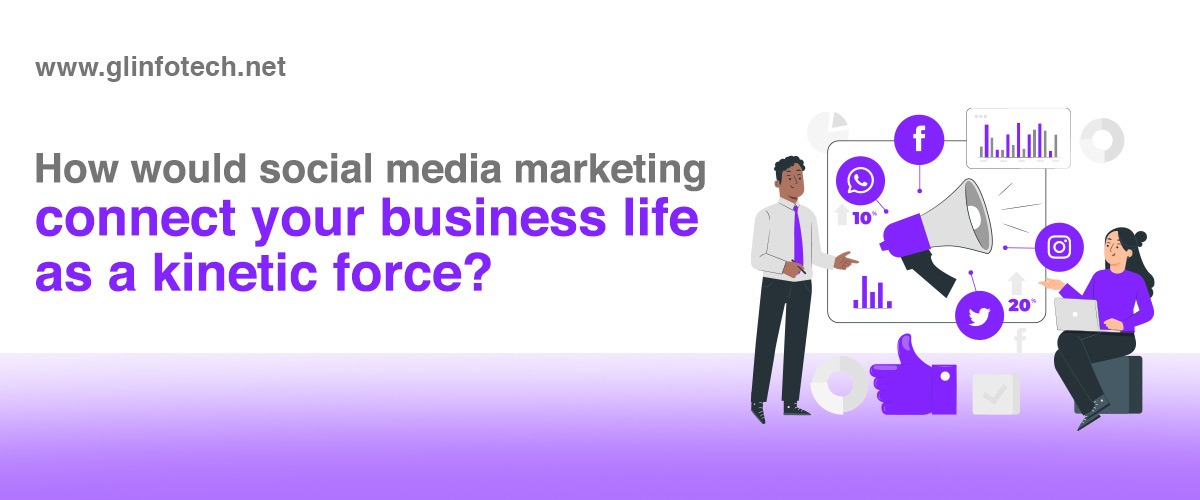
>
How would social media marketing connect your business life as a kinetic force?

Social media marketing is the best-yielding shield in the world of marketing competition arising and continuing with endless limitations.

It was evolving to make a space in your life as a member or your twin itself throughout these years as it began, and rapidly now created a virtual space because social media platform now is not only for individual use but is also for great advertising to digitally brand your products and services.

For a newcomer to the business world, you can blindly recommend social media marketing services as the first and best source of business promotion and easy start-up for any type of business since its services are uncountable. Social media marketing services include social media advertising which helps you reach out to a large number of your potential customers in easy steps at minimal cost by posting your ads. Here, now we starting to discuss more social media marketing benefits even if you know about its infinite possibilities.

Also Read: SEO Strategies: How to Boost Your Website Traffic

As we know, since social media is comparatively easy to handle for any group of people without having much more practice, everyone should recommend it. That’s why any kind of business should post their products and services on social media through impressive graphic design works and catchy content to get notified by the people. If you are not taking care of your business account page on social media, people think that it is a useless company and feels not worthy. At this point, social media needs creativity along with strategic measures.
digital marketing

According to the reports, social media marketing rapport all the business groups for the expected growth through regular monitoring. Its importance cannot be overstated even if it seems overwhelmed because 97% of marketers are using social media for business growth and 78% of sale team using it to outsell their peer group. The social media platform is the key element to great success in business with a scrutinized focus.

Also Read: 5 augmenting interventions of AI in digital marketing as a powerful automation weapon

Let’s examine the benefits of social media

Brand awareness: Social media grows your brand awareness by sharing your quotes and descriptions and making an image in people’s minds.

Promote products and services: Make social media pages for your business and link it through available sources to get to know about the business.

Reach to a large audience: This is one of the demands as well as the boon of marketers’. Which can reach a tremendous group of people by specified option in less amount of time.

Customer experience: More customers visit your product or services and if they are impressed by your latent services they will suggest you to others by excellent reviews.

digital marketing

What does social media direct towards?

Something which is useful to the client what they are looking for and also for the seller who initiates to make a business revenue. So, it is a mutual static between the B2C category. It is a simple and brilliant approach to improve the overall marketing campaign via direct connection to the immediate perplexing audience through social media. Social media services are some of the tremendously available services which allow you to make a direct connection between the company and the audience. When the audience chooses to like and follow your account, you can understand who is interested, how they expected, how much they have been influenced and at last what social media strategy is better to meet their need to adapt to existing account conditions.

The power of social media abilities is beyond our imagination. In this digital era, new generations are really fortunate for having such great prospects in social media, especially for marketers, entrepreneurs, marketers or even bloggers when they could able to use these benefits to the fullest. The suggested way to connect your audience instantly is by creating such a pleasing influential media presence is the primary key to forming persuasive content. Therefore, every business needs social media marketing which is very beneficial for growth.

Also Read: The Benefits of Branding: How a Strong Brand Identity Boosts Business Growth

Finally, you need an effective conversion from your business page to get the necessary budget action from clients. Here, the main conversion in a massive way is created through websites. This is where the importance of the website took place. A website that redirects through your social media campaign should be solid and well-executed to make a heart throbbing experience for the effective utilization of your marketing efforts.

For collecting potential customers, make your website the first point of contact by putting forward your foot through an effective presentation of professional and user-friendly website design.

You Can Read: E-commerce in 2025: Key Trends Shaping the Future

Just keep 2 tactics to maintain and increase your customers through social media services by connecting web design:

Best user experience: Make some realistic and attractive elements to catch the attention of users. Otherwise, visitors may get frustrated and leave due to large images and flashy videos that slow down the loading time. Make easy and quick navigation to improve the scalability of the website.

Advertising: It is the best way to make seamless clicks from ads to the landing page and make the visitors take the desired actions spontaneously.

Ready to transform your business with the power of social media marketing? Imagine it as the kinetic force that drives your brand forward, building momentum and creating lasting impact. If you’re looking to elevate your business’s online presence, trust the experts at a Digital Marketing Agency in Kerala to harness the full potential of social media.

Web Design & Development Ecommerce Web Development ERP Software Development

Mobile App Development Digital Marketing SEO Graphic Design

Latest Blogs
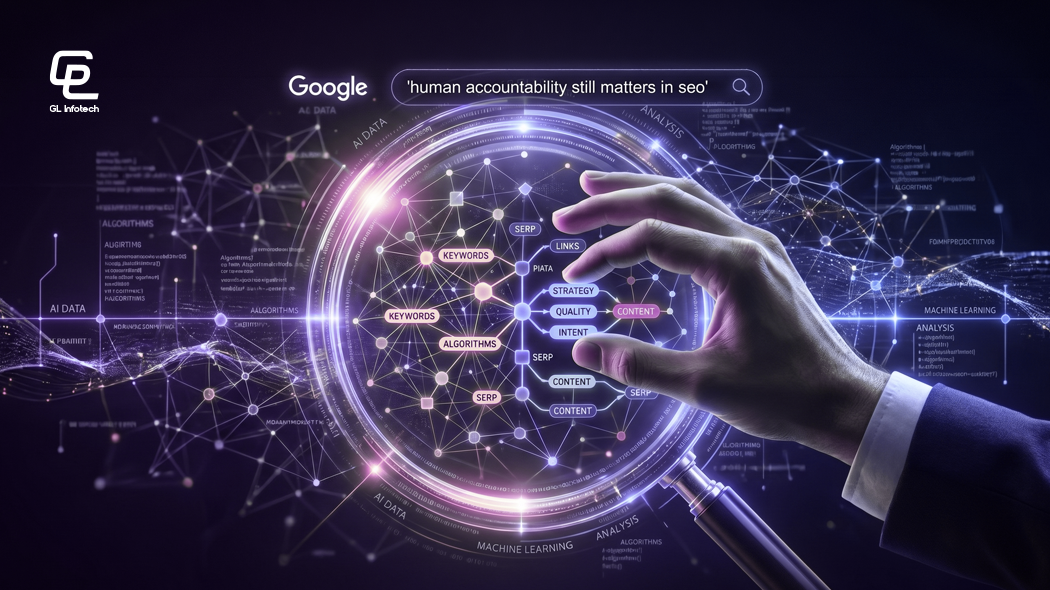
Google’s Standards Haven’t Changed — AI Makes It More Obvious: Why Human Accountability Still Matters in SEO
As AI-generated content becomes increasingly common, the conversation around content quality, trust, and search visibility is more important than ever. While AI tools have transformed how quickly content can be produced, Google's core standards for evaluating content remain unchanged. This article explores why human accountability continues to play a critical role in SEO, how Google's quality systems assess AI-generated content, and what businesses and content creators must do to maintain credibility and search performance in an AI-driven landscape. There's a conversation happening in every content team right now: how much can we let AI content creation handle?  The answer, if you're thinking about SEO, is simpler than most people want to admit. AI can do a lot. But it can't be accountable. And accountability is exactly what Google has always rewarded. The Rules Didn't Change. The Shortcuts Did. Google's quality standards aren't new. E-E-A-T — Experience, Expertise, Authoritativeness, and Trustworthiness — has been the framework for years. The Helpful Content system, the Quality Rater Guidelines, the spam policies — all of it has been there, quietly filtering out content that exists to game rankings rather than genuinely help people. What changed is the volume and speed at which low-quality content can now be produced. AI tools made it possible to flood the web with thousands of articles overnight. Google's systems responded by getting better at identifying what's hollow — not because it's AI content, but because it lacks the signals of real thought, real expertise, and real accountability.  Google has been consistent on this for years: using automation to generate content with the primary purpose of manipulating rankings is a violation of its spam policies. That line hasn't moved. Only the methods have. What Google Is Actually Looking For in AI Content and SEO Google's systems prioritize content based on who created it, how it was produced, and most importantly, why it was created. If the "why" is primarily to attract search engine visits, that's not what Google's systems are designed to reward. This is where human accountability comes in. A human writer — or a human editor reviewing AI output — brings something the tool can't generate on its own: the willingness to put their name on it. That's not a soft metric. It's the foundation of every quality signal Google measures. Author information, cited sources, original insight, verifiable claims — these are all byproducts of someone taking ownership of what they publish. Every piece of AI-generated content should be reviewed, fact-checked, and where necessary, edited by a human with relevant expertise. Not as a formality. As the actual work. AI Is a Tool. Not the Writer. The brands and SEO teams seeing consistent results aren't abandoning AI — they're using it correctly. AI handles the draft. Humans handle the thinking. The research, the angle, the accuracy check, the editorial judgment — that's still human work. The practical question for SEO hasn't changed since Google's early quality guidelines: Does the content provide original reporting, original research, or original analysis? Is it something you'd be comfortable putting your name on? That question cuts through all the noise. If the answer is yes, the content will likely perform. If it's no, no amount of optimization will fix it. Human Accountability Remains the Ranking Factor  Successful SEO strategies don't depend on publishing more AI content. They depend on using AI responsibly while maintaining human oversight, expertise, and accountability. AI didn't change what Google wanted. It just made it harder to fake. The sites that rank well today are the ones where someone still cares enough to verify, edit, and take responsibility for what goes live. That human layer isn't optional — it's the whole point.
June 23, 2026
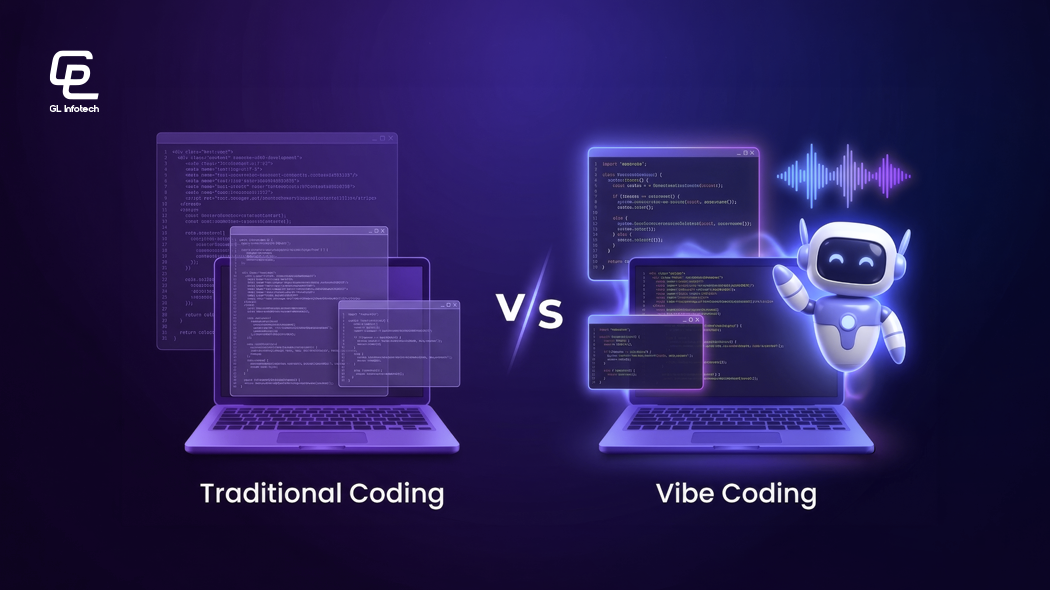
Traditional Coding vs. Vibe Coding: The Future of Software Development Is Already Here
Is traditional coding still the gold standard, or is vibe coding the future? Discover how AI-assisted development is changing the way software is built, why tools like GitHub Copilot are gaining momentum, and what this shift means for the future of software engineering. Software development has come a long way from writing thousands of lines of code by hand, like manually, literally. Nowadays artificial intelligence is doing this shift in how apps get built, assessed, and released. Even so, the classic coding approach still sits as the backbone of modern software engineering, a new approach called what is vibe coding is gaining attention for its speed, accessibility, and creativity. But does vibe coding replace traditional programming, or does it complement it? Let us now examine how the two are different from one another, and why they will influence the future of software engineering. Traditional Coding: The Art of Building from the Ground Up Manual Coding involves the use of traditional coding methods whereby the programmers write, debug and maintain the codes manually by use of languages like Python, Java, and C++. This approach gives engineers complete control over every aspect of a software system. Key characteristics include :- -Full control over architecture, logic, and security. -Predictable and reproducible outputs. -Strong focus on algorithms and data structures. -Deep understanding of programming languages. -Better handling of complex enterprise applications. -Precise management of edge cases and performance optimization. Traditional coding still kind of matters a lot for big scale systems where reliability, security, and scalability really have to be on point. Even if it takes a lot of expertise, a ton of time too, it gives that needed flexibility to craft custom solutions that are kind of tailored. What Is Vibe Coding? A New Way to Create Software So, what is vibe coding? Vibe coding is basically a modern software development routine where you talk through your idea in plain English, and then AI tools generate, refine , and fix the code with you. It’s sort of like you don’t get stuck on syntax all the time, you instead keep your attention on the overall product vision , while the AI takes care of a big chunk of the implementation details. So the whole vibe is more about intent and less about wrestling with the mechanics, even if you are still steering it the entire way. Why is it becoming so popular? -Rapid prototyping and faster development cycles. -Lower technical barriers for beginners. -Greater focus on creativity and problem-solving. -Reduced time spent writing repetitive code. -Faster experimentation with new ideas. -Easier collaboration between technical and non-technical teams. Vibe coding allows ideas to move from concept to working prototype in hours rather than weeks, making innovation more accessible than ever before. The Rise of GitHub Copilots and AI-Powered Development One of the key factors behind the evolution of the software industry towards vibe coding is GitHub copilots and other AI-assisted programming tools. Such intelligent assistants function directly in the programming environment and help programmers to develop more efficient software products faster. Key benefits include :- -Context-aware code suggestions. -Automated test generation. -Faster debugging and code reviews. -Refactoring assistance. -Natural language explanations for complex code. -Improved productivity across development teams. Instead of substituting developers, these are AI-driven aides that make daily programming tasks easier. The Future of Software Engineering The future of software engineering will not be about people v/s AI; rather, it will be about collaboration. Software developers are slowly changing from being mere coders to becoming architects, strategists, and evaluators of intelligent machines. In the coming years, we can expect :- -More autonomous AI coding agents. -Natural language-driven development. -Faster software delivery cycles. -Smarter testing and maintenance processes. -Multi-model AI development environments. -Greater focus on innovation over manual coding. The developers who embrace both traditional programming skills and AI-assisted workflows will be best positioned for success. Conclusion Traditional coding and vibe coding are not competitors; they are partners in the next evolution of software development. While traditional coding provides the foundation for robust systems, vibe coding accelerates creativity and execution. Together, they represent the exciting future of software engineering, where human expertise and AI capabilities work hand in hand to build the next generation of digital experiences.
June 16, 2026
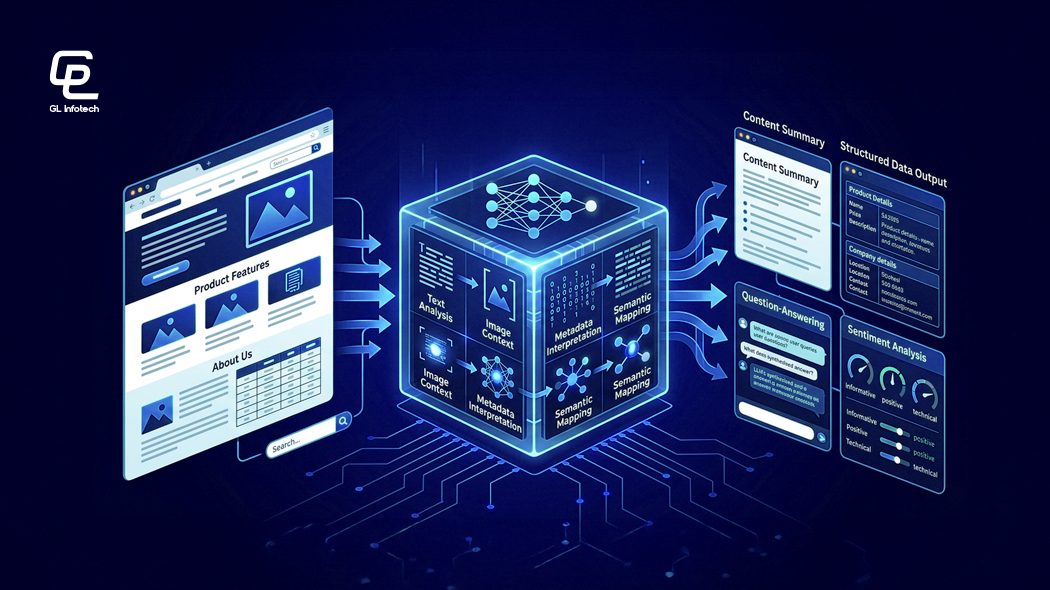
How Large Language Models (LLMs) Interpret Website Content
Search is shifting from keyword based ranking to AI driven interpretation. Large Language Models now read, analyze, and synthesize website content to generate answers directly. Understanding how these systems interpret information is essential for improving visibility, structure, and clarity in modern digital search environments. Something is happening to search and most websites have not fully realized it yet. For years, ranking on Google was the primary goal. Businesses optimized keywords, built backlinks, improved page speed, and structured content for crawlers. While those elements still matter, the rise of AI powered search has changed how content is consumed. Users are no longer always clicking links. Instead, they are getting direct answers from systems that read and interpret content on their behalf. This introduces a major shift. Your content is no longer just being ranked. It is being interpreted and synthesized by large language models. This raises an important question. How do these systems understand website content and why do some pages get referenced while others are ignored? The answer changes how SEO must be approached. At GL Infotech, we are closely aligned with how modern search is evolving and how large language models are reshaping content discovery and interpretation. AI Search Thinks Differently Than Traditional Search Traditional search engines are built to find and rank webpages. They crawl content, index it, and match it to user queries using keywords, backlinks, and authority signals. The result is a list of links that users explore. Large language models work differently. They do not stop at finding content. They interpret it. They analyze: Relationships between ideas Sentence meaning and structure Context across sections Intent behind information Instead of returning pages, AI systems generate responses. They extract useful insights from multiple sources and combine them into a single answer. This makes clarity extremely important. Content that is structured well is easier to interpret, while unclear content increases ambiguity. In simple terms:Search engines retrieve pagesAI systems understand meaning Why Content Structure Matters More Than Ever Structured data is still useful, but it is no longer the strongest signal. The actual structure of your content plays a bigger role in AI interpretation by large language models. Consider two articles: One is written in long paragraphs with weak headings The other is structured with clear sections and logical flow Both may contain the same information, but the second is easier to understand. llm models rely on structure to interpret meaning. They use: Headings to define topics Paragraphs to separate ideas Lists to group related points When structure is clear, large language models can extract information more accurately. When it is unclear, meaning becomes harder to identify. Many websites lose visibility not because of weak content, but because of weak structure. AI Search Is About Representation, Not Just Ranking Traditional SEO focuses on rankings and higher positions lead to more visibility. AI search changes this completely. Instead of showing links, llm models generate answers by combining information from multiple sources. This shifts competition from ranking pages to being included in the answer itself. That means: A single paragraph can be valuable A definition can be extracted directly A clear explanation can become a cited source Each section of content becomes independently important. Content is no longer evaluated only as a full page, but as smaller information units. How Large Language Models Identify Important Information large language models use content hierarchy to understand structure and meaning. Key signals include: Headings Headings define what a section is about and establish context before reading begins. Content Order Information placed earlier is often treated as more important in interpretation by llm models. Reinforcement Repeated ideas across sections are more likely to be identified as key themes by large language models. Section Clarity Clear separation between topics helps llm models understand relationships between ideas. In short:Better structure leads to better understanding. Why Clear Language Outperforms Complexity There is a common belief that complex language creates authority. In AI interpretation, clarity performs better. large language models are designed to extract meaning efficiently. When writing is clear, it becomes easier for llm models to interpret, summarize, and evaluate. This does not mean simplifying ideas. It means removing unnecessary complexity that creates confusion. Strong content: explains clearly avoids unnecessary jargon communicates one idea at a time The goal is not simplicity but it is the interpretability for large language models. Why Formatting Influences AI Visibility Formatting is not just visual, it is structural. It directly impacts how llm models process content. Useful formats include: Bullet points for grouped ideas Numbered steps for processes FAQs for direct answers Tables for comparisons Definitions for clarity These formats help large language models quickly identify what a section contains. Well-formatted content improves extraction accuracy and reduces ambiguity during interpretation by llm models. The Surprising Reason Keywords Still Matter Many assume keywords are no longer important in AI search.This is not entirely true. While AI systems understand context, retrieval still depends on language. Before content can be interpreted, it must first be found.That discovery process relies heavily on terminology used by large language models systems during retrieval.  For example, if a page discusses “AI systems” but never uses the term “Large Language Models,” llm models may not retrieve it for that query, even if the content is relevant. This shows a key distinction: Understanding is contextual Retrieval is linguistic AI may understand relationships, but large language models still use explicit language to locate content. So keywords remain important — not for manipulation, but for discoverability. Common Content Mistakes That Reduce AI Visibility Many websites unintentionally reduce visibility due to structure issues. Delayed key information Weak headings Dense paragraphs Topic shifts Content clutter These issues reduce how effectively llm models interpret content. Clean structure improves both human experience and how large language models process information. How To Create Content That AI Understands Creating AI-friendly content is not about changing strategy — it is about improving clarity. Key principles include: Introduce topic early Use logical content flow Keep one idea per paragraph Use structured formats where helpful Maintain consistent terminology Prioritize clarity over complexity The objective is simple: make content easy to understand for both humans and llm models. When writing for large language models, clarity always improves interpretability. The Future Of SEO In An AI-Driven World SEO is shifting from ranking optimization to interpretation optimization. Technical SEO still matters, but it is no longer sufficient for llm models alone. Future visibility depends on how well large language models can: understand content extract meaning and represent information accurately The most successful websites will not be those producing the most content, but those communicating ideas most clearly. In AI-driven search, content is no longer evaluated only by how well it ranks or how many signals it carries. It is evaluated by how effectively llm models can interpret it. Because of this, visibility is no longer just about being found. It is about being understood by large language models.
June 9, 2026
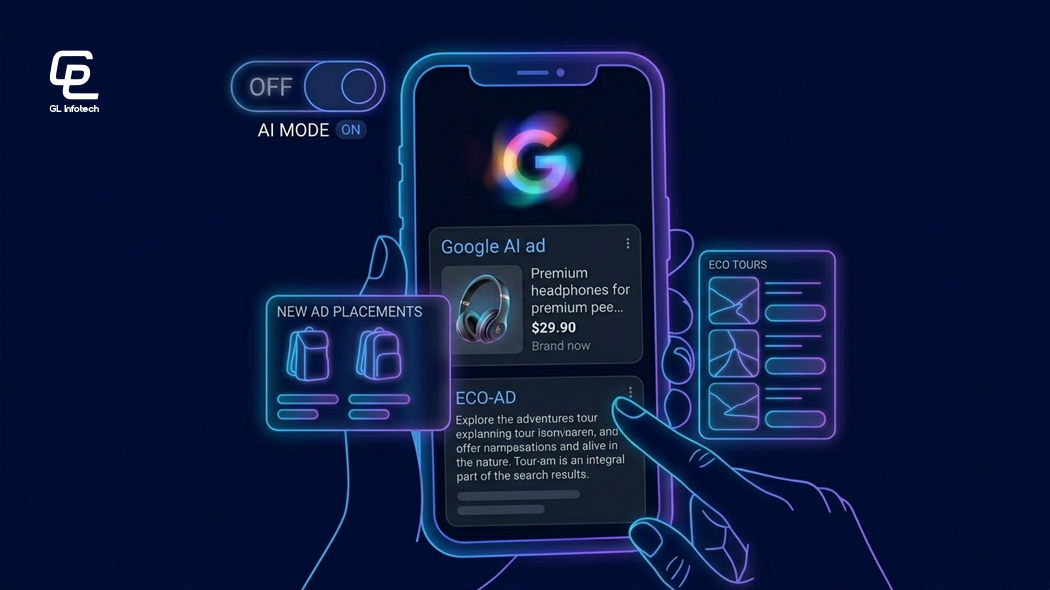
Google Expands AI Mode With New Ad Placements: What Advertisers Need to Know
As Google expands AI Mode with new advertising opportunities, the future of search marketing is rapidly evolving. From AI-powered ad placements to changes in campaign targeting and user behavior, advertisers need to adapt to stay competitive. This article examines the latest developments and what they mean for businesses using Google Ads. Search advertising is changing fast, and Google's AI Mode is at the center of it. If you're running paid campaigns, here's what's happening and why it matters right now. AI Mode Is No Longer a Niche Feature Google's AI Mode has grown nearly 4x since its May 2025 launch, reaching 75 million daily active users and over 100 million monthly active users across the US and India. The platform now processes over a billion queries every month - making it one of the fastest-growing search interfaces Google has ever launched. This isn't an experiment anymore. It's where a significant chunk of your audience is already searching. Ads Are Now Part of the AI Experience Advertising visibility alongside AI-generated results has expanded dramatically. Ads now appear at the bottom of approximately 25.5% of AI Overview search results, and Google's AI Mode infrastructure includes a ready-to-deploy ad placement called "AI Mode Bottom Ads," with hundreds of active experiment IDs testing monetization approaches. Every time a user searches in Google AI Mode, ad auctions are already running in the background and completing within 60 milliseconds — even in cases where no ads are currently displayed. Query-to-conversion attribution is also already live, tracking user journeys through AI Mode sessions. These new AI ad placements represent Google's latest effort to integrate advertising seamlessly into AI-powered search experiences.  The foundation is built. Broader rollout is a matter of when, not if. How Ads Appear in AI Mode Sponsored results in AI Mode surface as inline citations, sidebar recommendations, and post-response product listings across both commercial and informational queries.  A user searching something like "how to build a website for a small business with limited resources" might get a step-by-step AI guide, along with ads for website builders that are relevant to their needs. The ad doesn't interrupt the answer - it extends it. Which Campaigns Are Eligible? Advertisers using Google Ads campaigns such as Performance Max or the newer AI Max for Search campaigns automatically qualify for AI Mode placements. No separate campaign setup is needed, but asset quality and feed accuracy determine how often your ads actually appear. Search campaigns using Broad Match are also key here, since AI Mode queries tend to be conversational and long-tail - the kind that exact match keywords often miss entirely. What the Early Numbers Say Early performance data shows AI Mode ads generating stronger engagement than traditional search ads, but at a higher cost — roughly 18% higher engagement at a 35% higher CPC.  That's a meaningful trade-off. Users in AI Mode are in a deeper research mode, which means stronger intent - but advertisers will need to monitor ROI carefully as volume grows. Early data suggests that AI ad placements may become an important performance channel within the broader Google Ads ecosystem.  What's Coming Next Google is also introducing the concept of Promotion Bundling, whereby brands can upload promotions such as discounts, giveaways, and local coupons, and then employ AI to create effective promotional strategies based on the searches. Dedicated bidding options, campaign-specific targeting, and detailed performance reports for AI Mode placements are set to become available as these surfaces continue to evolve through 2026. Adapting to the AI Search Era AI Mode is reshaping how people search - and how ads reach them. The advertisers who start testing and optimizing now will have a significant head start over those who wait. Review your Performance Max assets, revisit your Broad Match strategy, and keep an eye on Google's rollout updates over the coming months. At GL Infotech, we help businesses stay visible as search continues to evolve. Whether it is SEO or Google Ads, our team can help you increase your chances of getting into Google AI Overview through the implementation of AI-powered search experience strategies.
June 3, 2026