>
Coronavirus disease 2019

COVID-19 is a contagious disease caused by the coronavirus SARS-CoV-2. In January 2020, the disease spread worldwide, resulting in the COVID-19 pandemic.

The symptoms of COVID‑19 can vary but often include fever,[7] fatigue, cough, breathing difficulties, loss of smell, and loss of taste.[8][9][10] Symptoms may begin one to fourteen days after exposure to the virus. At least a third of people who are infected do not develop noticeable symptoms.[11][12] Of those who develop symptoms noticeable enough to be classified as patients, most (81%) develop mild to moderate symptoms (up to mild pneumonia), while 14% develop severe symptoms (dyspnea, hypoxia, or more than 50% lung involvement on imaging), and 5% develop critical symptoms (respiratory failure, shock, or multiorgan dysfunction).[13] Older people have a higher risk of developing severe symptoms. Some complications result in death. Some people continue to experience a range of effects (long COVID) for months or years after infection, and damage to organs has been observed.[14] Multi-year studies on the long-term effects are ongoing.[15]

COVID‑19 transmission occurs when infectious particles are breathed in or come into contact with the eyes, nose, or mouth. The risk is highest when people are in close proximity, but small airborne particles containing the virus can remain suspended in the air and travel over longer distances, particularly indoors. Transmission can also occur when people touch their eyes, nose, or mouth after touching surfaces or objects that have been contaminated by the virus. People remain contagious for up to 20 days and can spread the virus even if they do not develop symptoms.[16]

Testing methods for COVID-19 to detect the virus’s nucleic acid include real-time reverse transcription polymerase chain reaction (RT‑PCR),[17][18] transcription-mediated amplification,[17][18][19] and reverse transcription loop-mediated isothermal amplification (RT‑LAMP)[17][18] from a nasopharyngeal swab.[20]

Several COVID-19 vaccines have been approved and distributed in various countries, many of which have initiated mass vaccination campaigns. Other preventive measures include physical or social distancing, quarantining, ventilation of indoor spaces, use of face masks or coverings in public, covering coughs and sneezes, hand washing, and keeping unwashed hands away from the face. While drugs have been developed to inhibit the virus, the primary treatment is still symptomatic, managing the disease through supportive care, isolation, and experimental measures.


Latest Blogs
Sensible Medical insurance Preparations
ghstbuyer 070726 Mandating this type of extremely important health and fitness benefits guarantees complete coverage for those and you may household, dealing with the diverse health care requires. These types of benefits tend to be emergency characteristics, maternity and you may newborn proper care, psychological state and you can compound fool around with sickness features, prescribed drugs, and a lot more. The marketplace  provides multiple choices to be sure medical insurance is accessible and you can affordable to have many anyone. To get very important information and you will condition from the medical insurance, sign up for current email address and text message notification to own prompt reminders and you may crucial guidance.Seek out availability, while the never assume all material top preparations can be found in all areas.Which brings a critical pathway so you can sensible visibility for legitimately establish immigrants which you will if not face a gap within the insurance choices.Find out about what goes on that have representative exposure once Individual & Family members Package (IFP) termination to the December 31, 2025.See how to register Protector’s increasing circle out of dental work with team. Taking a medical Insurance policies Markets® plan: cuatro procedures By understanding and making use of the brand new Special Subscription Months, you could take care of persisted health coverage and prevent holes in your insurance rates.Mental health hotlines you to suffice rural groups have experienced an enthusiastic uptick inside the calls.Issues that enable you to subscribe medical health insurance outside Open Enrollment.You might be qualified to receive another Subscription Several months for those who features a major lifestyle knowledge.Might significantly enhance your odds of to stop a gap inside acquiring it help if you digitally document the taxation return with Form 8962 because of the deadline of the go back. This web site doesn't display the offered preparations. † CSRs variations out of Restricted and you will No can also be found for the most other metal level agreements for people in federally approved tribes and you will ANCSA corporation investors. You will find a supplementary premium recharged of these elective benefits.
July 7, 2026
Google’s Standards Haven’t Changed — AI Makes It More Obvious: Why Human Accountability Still Matters in SEO
As AI-generated content becomes increasingly common, the conversation around content quality, trust, and search visibility is more important than ever. While AI tools have transformed how quickly content can be produced, Google's core standards for evaluating content remain unchanged. This article explores why human accountability continues to play a critical role in SEO, how Google's quality systems assess AI-generated content, and what businesses and content creators must do to maintain credibility and search performance in an AI-driven landscape. There's a conversation happening in every content team right now: how much can we let AI content creation handle?  The answer, if you're thinking about SEO, is simpler than most people want to admit. AI can do a lot. But it can't be accountable. And accountability is exactly what Google has always rewarded. The Rules Didn't Change. The Shortcuts Did. Google's quality standards aren't new. E-E-A-T — Experience, Expertise, Authoritativeness, and Trustworthiness — has been the framework for years. The Helpful Content system, the Quality Rater Guidelines, the spam policies — all of it has been there, quietly filtering out content that exists to game rankings rather than genuinely help people. What changed is the volume and speed at which low-quality content can now be produced. AI tools made it possible to flood the web with thousands of articles overnight. Google's systems responded by getting better at identifying what's hollow — not because it's AI content, but because it lacks the signals of real thought, real expertise, and real accountability.  Google has been consistent on this for years: using automation to generate content with the primary purpose of manipulating rankings is a violation of its spam policies. That line hasn't moved. Only the methods have. What Google Is Actually Looking For in AI Content and SEO Google's systems prioritize content based on who created it, how it was produced, and most importantly, why it was created. If the "why" is primarily to attract search engine visits, that's not what Google's systems are designed to reward. This is where human accountability comes in. A human writer — or a human editor reviewing AI output — brings something the tool can't generate on its own: the willingness to put their name on it. That's not a soft metric. It's the foundation of every quality signal Google measures. Author information, cited sources, original insight, verifiable claims — these are all byproducts of someone taking ownership of what they publish. Every piece of AI-generated content should be reviewed, fact-checked, and where necessary, edited by a human with relevant expertise. Not as a formality. As the actual work. AI Is a Tool. Not the Writer. The brands and SEO teams seeing consistent results aren't abandoning AI — they're using it correctly. AI handles the draft. Humans handle the thinking. The research, the angle, the accuracy check, the editorial judgment — that's still human work. The practical question for SEO hasn't changed since Google's early quality guidelines: Does the content provide original reporting, original research, or original analysis? Is it something you'd be comfortable putting your name on? That question cuts through all the noise. If the answer is yes, the content will likely perform. If it's no, no amount of optimization will fix it. Human Accountability Remains the Ranking Factor  Successful SEO strategies don't depend on publishing more AI content. They depend on using AI responsibly while maintaining human oversight, expertise, and accountability. AI didn't change what Google wanted. It just made it harder to fake. The sites that rank well today are the ones where someone still cares enough to verify, edit, and take responsibility for what goes live. That human layer isn't optional — it's the whole point.
June 23, 2026
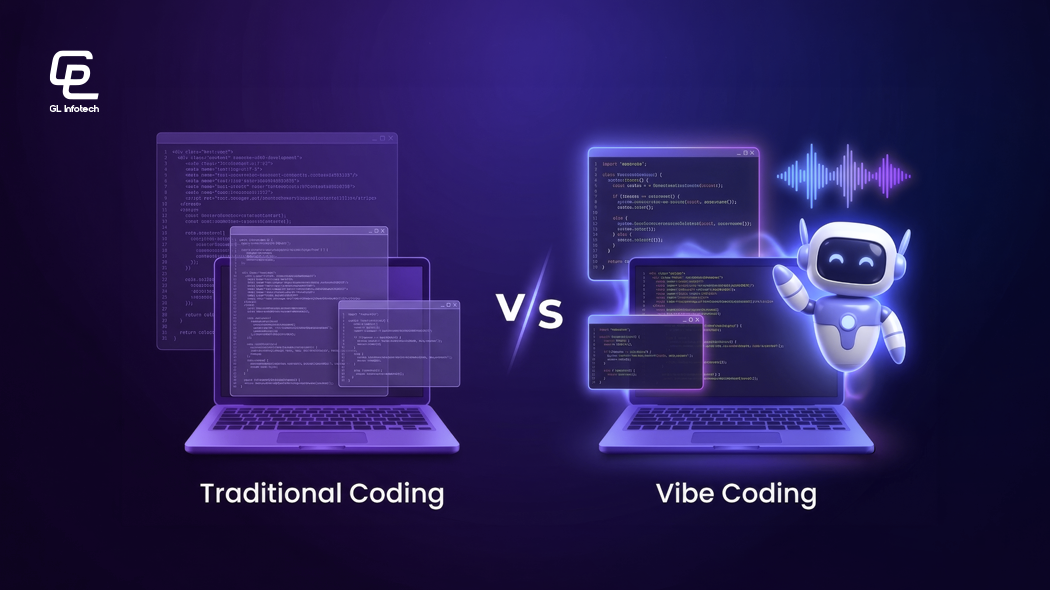
Traditional Coding vs. Vibe Coding: The Future of Software Development Is Already Here
Is traditional coding still the gold standard, or is vibe coding the future? Discover how AI-assisted development is changing the way software is built, why tools like GitHub Copilot are gaining momentum, and what this shift means for the future of software engineering. Software development has come a long way from writing thousands of lines of code by hand, like manually, literally. Nowadays artificial intelligence is doing this shift in how apps get built, assessed, and released. Even so, the classic coding approach still sits as the backbone of modern software engineering, a new approach called what is vibe coding is gaining attention for its speed, accessibility, and creativity. But does vibe coding replace traditional programming, or does it complement it? Let us now examine how the two are different from one another, and why they will influence the future of software engineering. Traditional Coding: The Art of Building from the Ground Up Manual Coding involves the use of traditional coding methods whereby the programmers write, debug and maintain the codes manually by use of languages like Python, Java, and C++. This approach gives engineers complete control over every aspect of a software system. Key characteristics include :- -Full control over architecture, logic, and security. -Predictable and reproducible outputs. -Strong focus on algorithms and data structures. -Deep understanding of programming languages. -Better handling of complex enterprise applications. -Precise management of edge cases and performance optimization. Traditional coding still kind of matters a lot for big scale systems where reliability, security, and scalability really have to be on point. Even if it takes a lot of expertise, a ton of time too, it gives that needed flexibility to craft custom solutions that are kind of tailored. What Is Vibe Coding? A New Way to Create Software So, what is vibe coding? Vibe coding is basically a modern software development routine where you talk through your idea in plain English, and then AI tools generate, refine , and fix the code with you. It’s sort of like you don’t get stuck on syntax all the time, you instead keep your attention on the overall product vision , while the AI takes care of a big chunk of the implementation details. So the whole vibe is more about intent and less about wrestling with the mechanics, even if you are still steering it the entire way. Why is it becoming so popular? -Rapid prototyping and faster development cycles. -Lower technical barriers for beginners. -Greater focus on creativity and problem-solving. -Reduced time spent writing repetitive code. -Faster experimentation with new ideas. -Easier collaboration between technical and non-technical teams. Vibe coding allows ideas to move from concept to working prototype in hours rather than weeks, making innovation more accessible than ever before. The Rise of GitHub Copilots and AI-Powered Development One of the key factors behind the evolution of the software industry towards vibe coding is GitHub copilots and other AI-assisted programming tools. Such intelligent assistants function directly in the programming environment and help programmers to develop more efficient software products faster. Key benefits include :- -Context-aware code suggestions. -Automated test generation. -Faster debugging and code reviews. -Refactoring assistance. -Natural language explanations for complex code. -Improved productivity across development teams. Instead of substituting developers, these are AI-driven aides that make daily programming tasks easier. The Future of Software Engineering The future of software engineering will not be about people v/s AI; rather, it will be about collaboration. Software developers are slowly changing from being mere coders to becoming architects, strategists, and evaluators of intelligent machines. In the coming years, we can expect :- -More autonomous AI coding agents. -Natural language-driven development. -Faster software delivery cycles. -Smarter testing and maintenance processes. -Multi-model AI development environments. -Greater focus on innovation over manual coding. The developers who embrace both traditional programming skills and AI-assisted workflows will be best positioned for success. Conclusion Traditional coding and vibe coding are not competitors; they are partners in the next evolution of software development. While traditional coding provides the foundation for robust systems, vibe coding accelerates creativity and execution. Together, they represent the exciting future of software engineering, where human expertise and AI capabilities work hand in hand to build the next generation of digital experiences.
June 16, 2026
?>