 >
>
Traditional Coding vs. Vibe Coding: The Future of Software Development Is Already Here
Is traditional coding still the gold standard, or is vibe coding the future? Discover how AI-assisted development is changing the way software is built, why tools like GitHub Copilot are gaining momentum, and what this shift means for the future of software engineering.
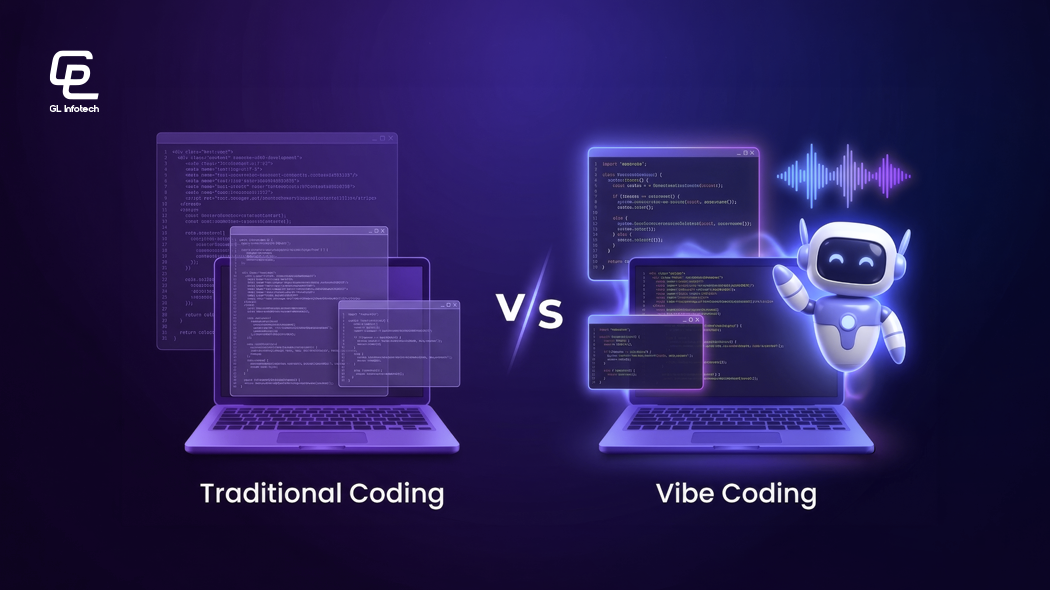
Software development has come a long way from writing thousands of lines of code by hand, like manually, literally. Nowadays artificial intelligence is doing this shift in how apps get built, assessed, and released. Even so, the classic coding approach still sits as the backbone of modern software engineering, a new approach called what is vibe coding is gaining attention for its speed, accessibility, and creativity.
But does vibe coding replace traditional programming, or does it complement it? Let us now examine how the two are different from one another, and why they will influence the future of software engineering.
Traditional Coding: The Art of Building from the Ground Up
Manual Coding involves the use of traditional coding methods whereby the programmers write, debug and maintain the codes manually by use of languages like Python, Java, and C++. This approach gives engineers complete control over every aspect of a software system.
Key characteristics include :-
-Full control over architecture, logic, and security.
-Predictable and reproducible outputs.
-Strong focus on algorithms and data structures.
-Deep understanding of programming languages.
-Better handling of complex enterprise applications.
-Precise management of edge cases and performance optimization.
Traditional coding still kind of matters a lot for big scale systems where reliability, security, and scalability really have to be on point. Even if it takes a lot of expertise, a ton of time too, it gives that needed flexibility to craft custom solutions that are kind of tailored.
What Is Vibe Coding? A New Way to Create Software
So, what is vibe coding? Vibe coding is basically a modern software development routine where you talk through your idea in plain English, and then AI tools generate, refine , and fix the code with you. It’s sort of like you don’t get stuck on syntax all the time, you instead keep your attention on the overall product vision , while the AI takes care of a big chunk of the implementation details. So the whole vibe is more about intent and less about wrestling with the mechanics, even if you are still steering it the entire way.
Why is it becoming so popular?
-Rapid prototyping and faster development cycles.
-Lower technical barriers for beginners.
-Greater focus on creativity and problem-solving.
-Reduced time spent writing repetitive code.
-Faster experimentation with new ideas.
-Easier collaboration between technical and non-technical teams.
Vibe coding allows ideas to move from concept to working prototype in hours rather than weeks, making innovation more accessible than ever before.
The Rise of GitHub Copilots and AI-Powered Development
One of the key factors behind the evolution of the software industry towards vibe coding is GitHub copilots and other AI-assisted programming tools. Such intelligent assistants function directly in the programming environment and help programmers to develop more efficient software products faster.
Key benefits include :-
-Context-aware code suggestions.
-Automated test generation.
-Faster debugging and code reviews.
-Refactoring assistance.
-Natural language explanations for complex code.
-Improved productivity across development teams.
Instead of substituting developers, these are AI-driven aides that make daily programming tasks easier.
The Future of Software Engineering
The future of software engineering will not be about people v/s AI; rather, it will be about collaboration. Software developers are slowly changing from being mere coders to becoming architects, strategists, and evaluators of intelligent machines.
In the coming years, we can expect :-
-More autonomous AI coding agents.
-Natural language-driven development.
-Faster software delivery cycles.
-Smarter testing and maintenance processes.
-Multi-model AI development environments.
-Greater focus on innovation over manual coding.
The developers who embrace both traditional programming skills and AI-assisted workflows will be best positioned for success.
Conclusion
Traditional coding and vibe coding are not competitors; they are partners in the next evolution of software development. While traditional coding provides the foundation for robust systems, vibe coding accelerates creativity and execution. Together, they represent the exciting future of software engineering, where human expertise and AI capabilities work hand in hand to build the next generation of digital experiences.